
First Things First - Why Another Substack?
One can drown in the sea of information and opinions, or step back and start from scratch

With so many great blogs here on substack and elsewhere on science, psychology and behaviour, autism, brain development and function, brain-body axis and health, even metabolic psychiatry and the science of energy, and much else that this stack will be touching on or diving deep into, is there room for more?
Is there room for another angle of seeing and connecting what is known, and probing what is yet unknown?
Much more than “autism”
It is a sad truth that individuals diagnosed with autism are at much higher risk of developing almost every other psychiatric, neurological, neurodegenerative disorder - Parkinson’s, psychosis, epilepsy, depression, ADHD, anxiety, dementia, obsessive-compulsive, bipolar disorder…name it.
Apart from the disorders of the brain, those diagnosed with autism (of any severity level) also suffer many other medical conditions, and die much, much younger, than people without autism: cardiovascular diseases, metabolic and respiratory disorders, infectious, inflammatory and autoimmune diseases, bone, muscle and connective tissue disorders…
Getting to the bottom of what drives the emergence of autism symptoms, on a cellular-bioenergetic level, will open up our understanding of so much else. This Substack will attempt to nibble at those connections.
Overcoming the status quo by embracing ‘first principles thinking’
First principles thinking is a method of breaking down complex problems into their most basic elements in order to gain deeper understanding and find effective solutions. Instead of relying on assumptions and common practices you ask what is actually true and reason upward from there.
So, instead of looking at ‘autism’ or ADHD symptoms and behaviours through the prism of diagnostic labels and relying on flawed assumptions (‘people with autism do not want to socialise’ is just one of many) and dogmas, we probe further and deeper until we deconstruct the issues we are facing into their most basic building blocks.
‘Transplanting’ and translating the science
The human body is a complex and highly interconnected system. Cells, tissues and organs are part of one whole, working together to keep the body alive. Always communicating, reacting, adjusting, not just to each other but to signals coming from the outside environment (as well as the ‘internal environment’ of the microbiome). Yet science operates in silos, and so does medicine.
Even when two fields attempt to merge under a new flag - neuroimmunology, for example - this new field will tend to consider only two small cogs in a vast system. A rheumatologist who sees a large number of adolescents with autism in his clinic, even if he is up to date on the likely connection between connective tissue disorders, inflammation and ‘psychiatric’ behaviors, will likely be unaware of the basic-science findings showing suboptimal cellular energy metabolism being a major driver of connective tissue inflammation and auto-reactivity. A researcher looking at endothelial cell metabolism in a Parkinson’s mouse model won’t be aware of how well her curious findings fit into what we know about autism, and how merging her lines of inquiry could revolutionise both fields. And so on.
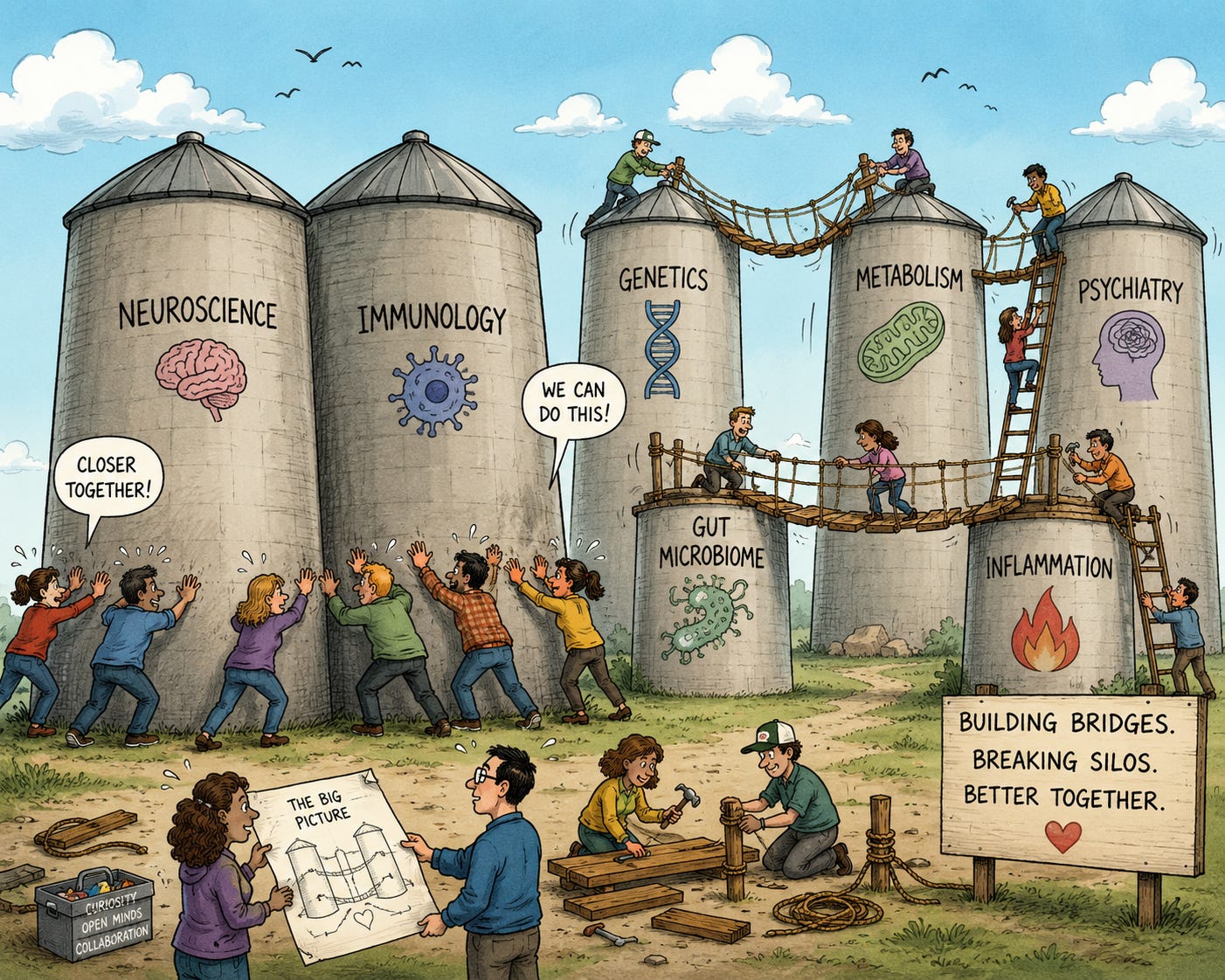
But how do we transplant knowledge between fields? How do we move those massive science silos closer to each other, or build solid-structure bridges between them? I have no idea but I feel we need to at least work from the principle of ‘this is what needs to happen’ in order to inform and inspire and move us forward in big leaps rather than tiny steps.
Just as important is the question of translating the scientific findings into common language. Bringing what we know from the labs down to earth, into everyday life, where it can be utilised to reduce suffering and provide better support, better understanding, better outcomes. This substack will attempt to have plain-language translations built into every article. This will be its biggest challenge.
Bridging! ❤️